Syllabus Entry No. 03
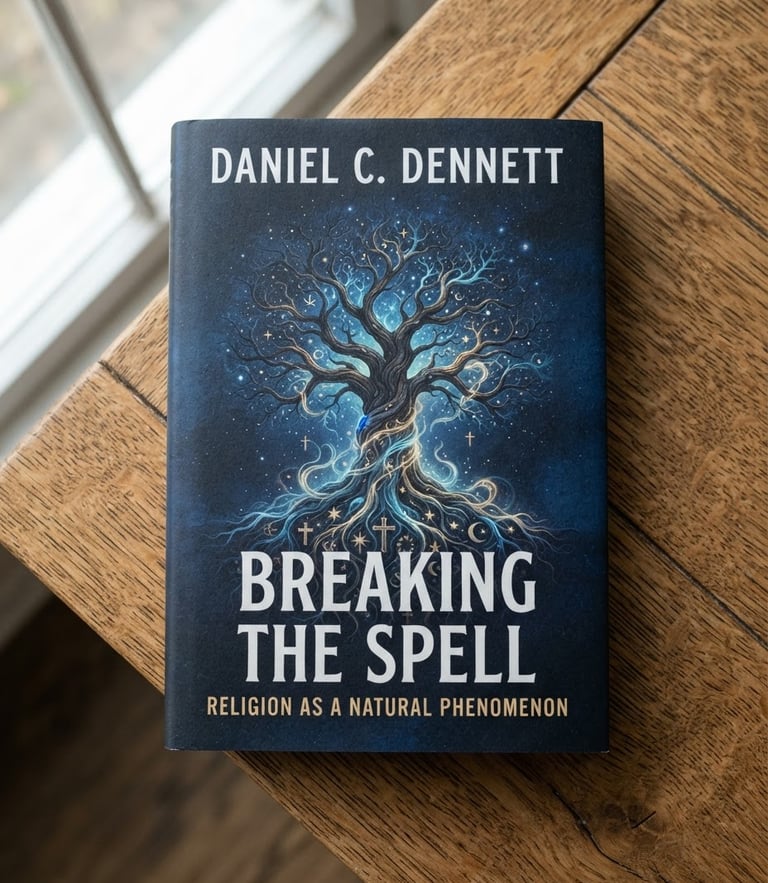
Breaking the Spell
While many books challenge the truth of religion, Breaking the Spell challenges the assumption that religion itself should be exempt from scientific scrutiny. Philosopher Daniel Dennett argues that religious belief is a natural human phenomenon that evolved over time and can be studied objectively using the tools of biology, psychology, anthropology, and cognitive science. Rather than ridiculing believers, Dennett asks readers to "break the spell" that discourages critical inquiry into religion's origins, functions, and persistence. His measured, thoughtful approach complements the more confrontational works of Dawkins and Hitchens, making this book an essential contribution to the atheist canon. For its originality, intellectual rigor, and pioneering exploration of religion as a subject for scientific investigation, Breaking the Spell deserves its place as the number three atheist book.
Religion is a natural phenomenon, and as such, it can and should be studied scientifically.
Dennett argues that the time has come to break the deep-seated cultural taboos that shield religious institutions and beliefs from empirical investigation.
How Ideas Replicate
Dennett applies evolutionary biology to cultural ideas, treating religious concepts as evolutionary memes that thrive by exploiting human cognitive architecture.
The Cognitive Machinery
Breaking the Taboo
Religious systems leverage our natural hyperactive agency detection device—the evolutionary tendency to attribute intention to the natural world.
By examining these beliefs under the light of evolutionary science, we do not diminish their history; we seek to understand their persistent survival.
First published in 2006, Breaking the Spell remains a cornerstone of the 'New Atheism' movement, emphasizing scientific curiosity over polemical debate.
The Secular Syllabus
A curated index of rationalist literature and secular inquiry.
The Index
Inquiries
editor@bestatheismbooks.com
Updated annually by the editorial board
© 2026 The Secular Syllabus-An independent index of rationalist literature.
A CURATED SYLLABUS OF SECULAR INQUIRY